
If you want a more regulated nervous system, optimize your restorative sleep.
You can be exhausted and still have trouble sleeping. You can spend eight hours in bed and wake up feeling as though you barely recovered.
And sometimes the problem isn’t that you don’t know how to sleep. Your body simply hasn’t received enough signals that it is safe to fully let go of the day.
I experienced this nearly daily through 10 years of active duty military service. It wasn’t quick and easy, but I eventually learned how to regulate my nervous system to promote restorative sleep at night , and let that restorative sleep promote nervous system regulation all day.
Nervous System Function
During the day, it helps you respond to deadlines, traffic, exercise, conversations, unexpected problems, and everything else life throws at you. Some of that activation is useful because you need your nervous system to respond when something requires your attention.
Sleep requires something different.
Your brain and body need to transition away from the demands of the day and into a physiological state that supports sleep maintenance, normal sleep cycling, and recovery.
This doesn’t mean your nervous system simply “turns off” when you fall asleep. In fact, the central and autonomic nervous systems remain closely coordinated throughout the night, changing their activity as you move through different sleep stages.
The important question is whether your body can shift gears appropriately.
I describe it to my clients as instead of trying to switch your brain from on to off, think about gliding and “downshifting” your brain to sleep. I didn’t have many of these opportunities during my military life, so I had to learn this skill after I separated from service.
Nervous System Regulation and Sleep
Sleep itself changes autonomic activity. With restorative sleep, your nervous system is better optimized.
Your autonomic nervous system helps regulate functions you don’t have to consciously control—heart rate, blood pressure, breathing, digestion and other automatic processes.
Two major branches are the sympathetic and parasympathetic nervous systems.
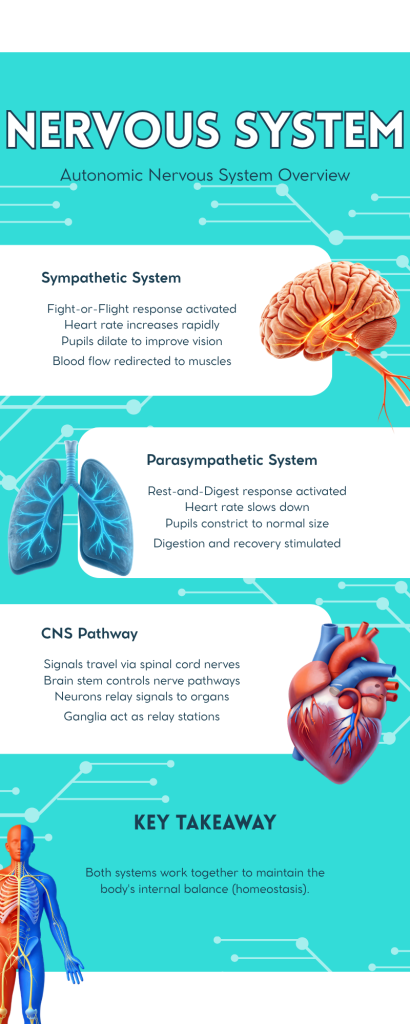
The sympathetic branch helps mobilize you for action.
The parasympathetic branch involves restoration and recovery. But these systems aren’t simply competing against each other. They continuously interact with the brain and the rest of the body.
Heart rate, breathing, blood pressure and other physiological processes shift as you move through non-REM and REM sleep. Research describes sleep as a coordinated interaction between the brain and autonomic nervous system rather than a period when one system simply shuts down.
This is one reason the phrase “restorative sleep” matters.
You can sleep for eight hours, but if it’s not restorative and go through three or four deep sleep cycles, you don’t get the rest and repair. This “light” sleep makes you subject to temperature changes, auditory interruptions and even the smallest of LED lights.
With restorative sleep, those six to eight hours slow your body down enough to where those potential interruptions are minimal and your body is better equipped to manage your nervous system.
The hyperarousal connection
If you are an insomniac and your nervous system feels dysregulated, there may be a connection.
Researchers have proposed that some people with insomnia experience a state of physiological and cognitive hyperarousal that makes it harder to initiate or maintain sleep.
There is evidence connecting insomnia with changes in cardiovascular autonomic activity, although researchers caution that the relationship is complicated and that the evidence does not prove that every person with insomnia has the same autonomic abnormality.
That distinction matters.
If you lie in bed thinking, I have to fall asleep right now, your brain may interpret the situation as a problem that needs to be solved, triggering that sympathetic system activation mentioned earlier.
Your body can remain alert even though you desperately want to sleep.
So instead of trying to “force” your nervous system to relax, it can be more useful to spend the day and evening giving your body repeated signals that it is safe to slow down into the parasympathetic state.
That brings us to the four domains that are the core of my sleep coaching work, and how I teach you to not dive into bed and hope for sleep; but glide through the night and land into sleep.
The end result of consistent, restorative sleep is consistent nervous system regulation.
1. Nutrition: Give Your Nervous System the Raw Materials It Needs
Eating a particular food at 9:00 p.m. isn’t going to guarantee restorative sleep at 10:00.
But your overall dietary pattern can influence the physiological environment in which sleep occurs.
Research has found associations between healthier dietary patterns and better sleep quality, while higher consumption of processed and free-sugar-rich foods has been associated with poorer sleep characteristics. Foods rich in fiber, fruits, vegetables and healthier unsaturated fats are generally associated with better sleep measures.
Your nervous system requires energy and nutrients to function. Food also affects blood glucose regulation, digestion, inflammation and the availability of compounds involved in neurotransmitter and hormone production.
During my military days, our meals were consumed very fast and focused on carbs and protein, and not nutrients that support sleep. When I transitioned into community mental health services, it was nearly the same diet pattern. I had the fuel to get me through the day, but not the fuel to support restorative sleep at night.
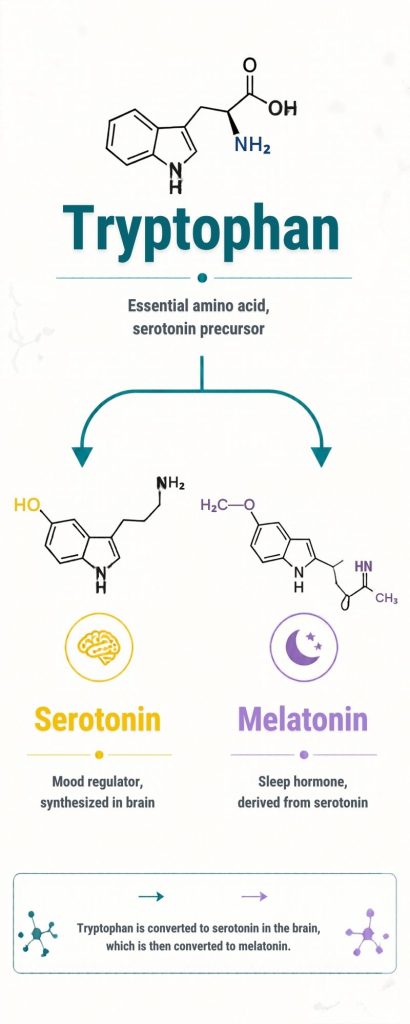
Tryptophan, for example, is involved in the pathway that produces serotonin and melatonin. Serotonin is what keeps your mood balanced throughout the day and helps communicate to the nervous system what is needed in the moment. Melatonin is what induces the body into stage 1 sleep and helps transition into the deep sleep stages.
Instead of searching for one “sleep food,” consider the bigger picture of including foods that have sleep-supporting nutrients.
Magnesium, B vitamins, iron, vitamin D and other nutrients are important to normal physiology. They build serotonin, dopamine, and other endorphins that support your parasympathetic system we talked about. You can start off slow by introducing foods with these nutrients.The goal is not to create a perfect diet. It is to give your body a reasonably consistent nutritional environment in which normal regulation can occur. Read more about nutrition and sleep in this FAQs section.
2. Body and Circulation: Teach Your Body What Recovery Feels Like
Your nervous system doesn’t exist separately from your body. Your heart, lungs, muscles and blood vessels are constantly communicating with your brain.
This is one reason physical activity can be relevant to sleep.
Regular exercise has been shown to influence heart-rate variability (HRV), a measurement commonly used to study autonomic regulation. A 2024 systematic review and meta-analysis of randomized controlled trials found that exercise training improved several HRV measures associated with autonomic function in healthy adults.
That doesn’t mean you need to exercise specifically to “increase your HRV.” It means that regular physical activity appears to help the cardiovascular system become more adaptable, and adaptability is important.
It’s like real life. Most days are probably on an even-keel basis for your heart, but exercising can better prepare you in handling the higher stress days and recovering faster.
Exercise is a useful stressor. Your body responds, adapts and becomes more capable. I also found that exercising took my mind off of mental stressors.
But if training load, work stress, inadequate nutrition and insufficient sleep continually pile up, adding more intensity isn’t necessarily the answer.
Research examining exercise and autonomic regulation after sleep deprivation has highlighted this distinction: regular exercise may support autonomic regulation, while very demanding exercise performed during significant sleep deprivation can create additional physiological stress.
Practical body strategies to improve nervous system regulation
Move during the day.
Walking, resistance training, cycling, swimming and other forms of physical activity can give your body a healthy reason to activate and recover. I’ve learned to move every hour by doing simple things like throwing away trash into the can furthest from my desk.
Try gentle stretching or mobility work in the evening.
The goal isn’t to create a workout. It is to transition your body toward a quieter state.
Experiment with slow breathing.
Slower breathing can influence autonomic activity and may be useful as part of a wind-down routine. Think comfortable and unforced rather than taking enormous breaths.
Pay attention to recovery.
If you train hard, recovery isn’t wasted time. It is part of the training process. Recovery includes short naps, massages, ice baths to reduce pain or warm baths to promote circulation. Learn more about recovery and impact on sleep on this page.
One useful way to think about it is:
Stress + recovery = adaptation.
Without enough recovery, stress simply accumulates.
3. Your Bedroom Environment Affects Sleep and Nervous System Regulation
Your bedroom doesn’t need to look like a luxury hotel. It needs to help your brain understand what usually happens there.
Temperature is particularly important. Your body naturally regulates temperature as part of the sleep process, and environmental heat can increase wakefulness while reducing both slow-wave sleep and REM sleep.
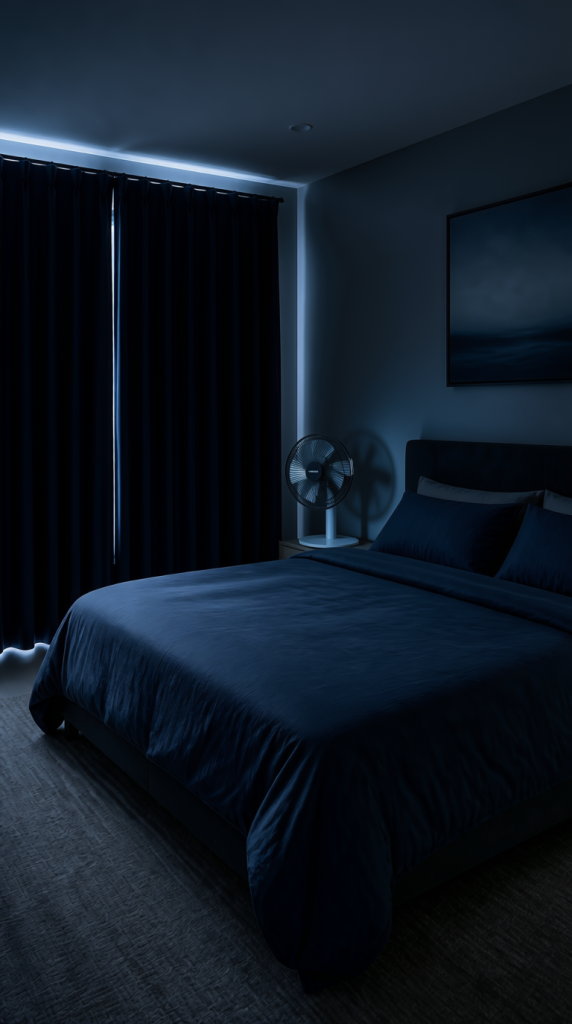
Practical bedroom strategies
Keep the room comfortably cool.
There isn’t one perfect temperature for everyone. Find the point where you aren’t waking because you’re overheated or chilled.
Reduce unpredictable noise.
If complete silence isn’t possible, consistent background sound may be less disruptive than sudden environmental noises. There are actually different “colors” for noise. Find out which one works best for you.
Make the bed physically comfortable.
Mattress, pillow, bedding and sleepwear all contribute to your thermal and physical environment.
Create consistency.
The more predictable the environment, the fewer decisions your brain has to make once you get into bed.
Your bedroom should communicate something simple:
This is where we recover.
4. Mindspace: Stress, Racing Thoughts, and Nervous System Regulation at Night
This may be the most familiar experience for people who struggle with insomnia and a dysregulated nervous system:
Your body is exhausted. But your brain starts reviewing tomorrow’s schedule. Then yesterday’s conversation. Then the problem at work. Then your finances. Then you realize you’re still awake. Then you look at the clock.
It’s 1:17. Now you’re worried because you have to get up at 6:30. That creates another layer of activation.
This is where mindspace becomes important.
The goal isn’t to eliminate every thought before bed. That’s unrealistic.
The goal is to change your relationship with those thoughts.
Practical mindspace strategies
Create a mental “parking lot.”
Write tomorrow’s tasks, concerns or reminders down before bed. You aren’t solving them. You’re giving your brain somewhere to store them. I advise my clients and teams to do this after dinner so that you have space to create practical solutions before going to bed versus waking up and trying to fix an emergency.
Have a predictable wind-down period.
Give yourself 20–60 minutes in which work, problem-solving and emotionally stimulating activities gradually decrease.
Stop checking the clock.
If knowing the exact time increases anxiety, turn the clock away. Also, stop using those sleep trackers! They can add more anxiety to your night!
Don’t make sleep another task to accomplish.
This one is difficult—but important. Sleep is something your body does. Your job is to create favorable conditions for it. And if you’re lying awake becoming increasingly frustrated, remember that struggling against wakefulness can become part of the problem.
One of my insomnia triggers was constantly thinking I left something unlocked or unsecured. 17 years of combined military and federal service on air force bases will do that to you.
I no longer had the responsibility of defending our nation, but my brain couldn’t get out of it.
So to help myself and get in the right mindspace, I started making a “shut down” checklist for the home and accomplishing it at the same time every night. That created closure, and I never woke up again in the middle of the night thinking I forgot something.
The Four Domains Work Together
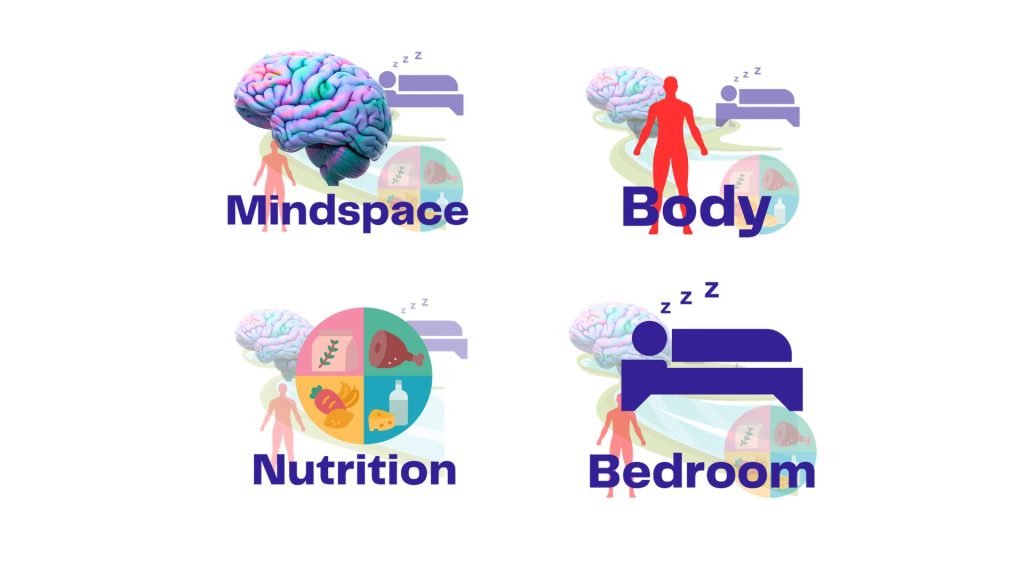
One of the biggest mistakes we can make with sleep is searching for one isolated solution.
Sometimes one change makes a substantial difference. I’m very honest about it in my book, “Sleep Reset in 12 Steps”. You may find that it wasn’t all 12 steps that helped you gain that extra hour or two; but one step you took very seriously for a few weeks that did the trick. One reader told me that the temperature control step had her husband sleeping better than he had in years.
But restorative sleep is a whole-body process.
Consider someone who exercises regularly but consumes caffeine late in the afternoon, works until 10 p.m., takes their phone into bed, sleeps in a hot bedroom and spends the first 30 minutes worrying about tomorrow.
They don’t necessarily have a single “sleep problem.”
They have several inputs telling their nervous system that the day isn’t over.
Now imagine changing just a few things:
- Caffeine is moved earlier.
- Dinner is more balanced and less heavy near bedtime.
- A hard workout is followed by adequate recovery.
- The bedroom becomes cooler and darker.
- Work stops 45 minutes before bed.
- Tomorrow’s tasks are written down.
- Ten minutes of quiet breathing replaces scrolling.
None of those changes guarantees perfect sleep.
But together, they create a very different physiological and psychological environment. That is the bigger lesson.
You Don't Need to "Turn Off" Your Nervous System
Your nervous system is not your enemy. And you certainly don’t need to panic when you notice that your heart is beating faster or your mind is active. Your nervous system is doing its job.
The goal is to help it recognize when the job has changed.
Daytime, exercise, problem-solving, driving, and work require activation.
Sleep requires a different pattern of activity.
The ability to move between those states—activation when needed and recovery when appropriate—is an important part of healthy physiological regulation.
Try this tonight
Instead of asking:
“What can I do to make myself fall asleep?”
Ask four different questions:
Nutrition:
Have I given my body what it needs today?
Body:
Have I moved, and have I allowed enough time for recovery?
Bedroom:
Does my environment support sleep rather than compete with it?
Mindspace:
Have I given my brain an opportunity to stop solving tomorrow’s problems?
You don’t have to change everything at once. Choose one area. Make one small adjustment.
Repeat it consistently. Then pay attention to what your body tells you. Because restorative sleep isn’t simply about spending more time in bed. It is about creating the conditions in which your brain and body can do what they were designed to do during sleep:
recover, regulate, repair and prepare you for another day.
If you found this helpful and would like more sleep knowledge going directly to your inbox, subscribe here.
Peer-Reviewed References
- Gordon C, et al. Heart rate variability in insomnia patients: A critical review of the literature. Sleep Medicine Reviews. 2017. PMID: 28187954.
- Burgess HJ, et al. Insomnia and cardiovascular autonomic control. Autonomic Neuroscience. 2019. PMID: 31331688.
- Silvani A, et al. Dynamic coupling between the central and autonomic nervous systems during sleep: A review. Sleep Medicine Reviews. 2018. PMID: 29608990.
- Godos J, et al. Association between diet and sleep quality: A systematic review. Sleep Medicine Reviews. 2021. PMID: 33549913.
- St-Onge MP, et al. Diet composition and objectively assessed sleep quality: A narrative review. Advances in Nutrition. 2022. PMID: 35063665.
- Grässler B, et al. Effects of Different Exercise Interventions on Cardiac Autonomic Control and Secondary Health Factors in Middle-Aged Adults: A Systematic Review. Journal of Cardiovascular Development and Disease. 2021. PMID: 34436236.
- Effects of Exercise Training on Heart Rate Variability in Healthy Adults: A Systematic Review and Meta-analysis of Randomized Controlled Trials. 2024. PMID: 39015867.
- Baniassadi A, et al. Sleep environments and sleep physiology: A review. PMID: 30509635.
- Okamoto-Mizuno K, Mizuno K. Effects of thermal environment on sleep and circadian rhythm. Journal of Physiological Anthropology. 2012. PMID: 22738673.
- Wang YY, et al. Mindfulness-Based Interventions for Insomnia: A Meta-Analysis of Randomized Controlled Trials. PMID: 30380915.
- Rash JA, Kavanagh VAJ, Garland SN. A Meta-Analysis of Mindfulness-Based Therapies for Insomnia and Sleep Disturbance: Moving Towards Processes of Change. Sleep Medicine Clinics. 2022. PMID: 36150798.